
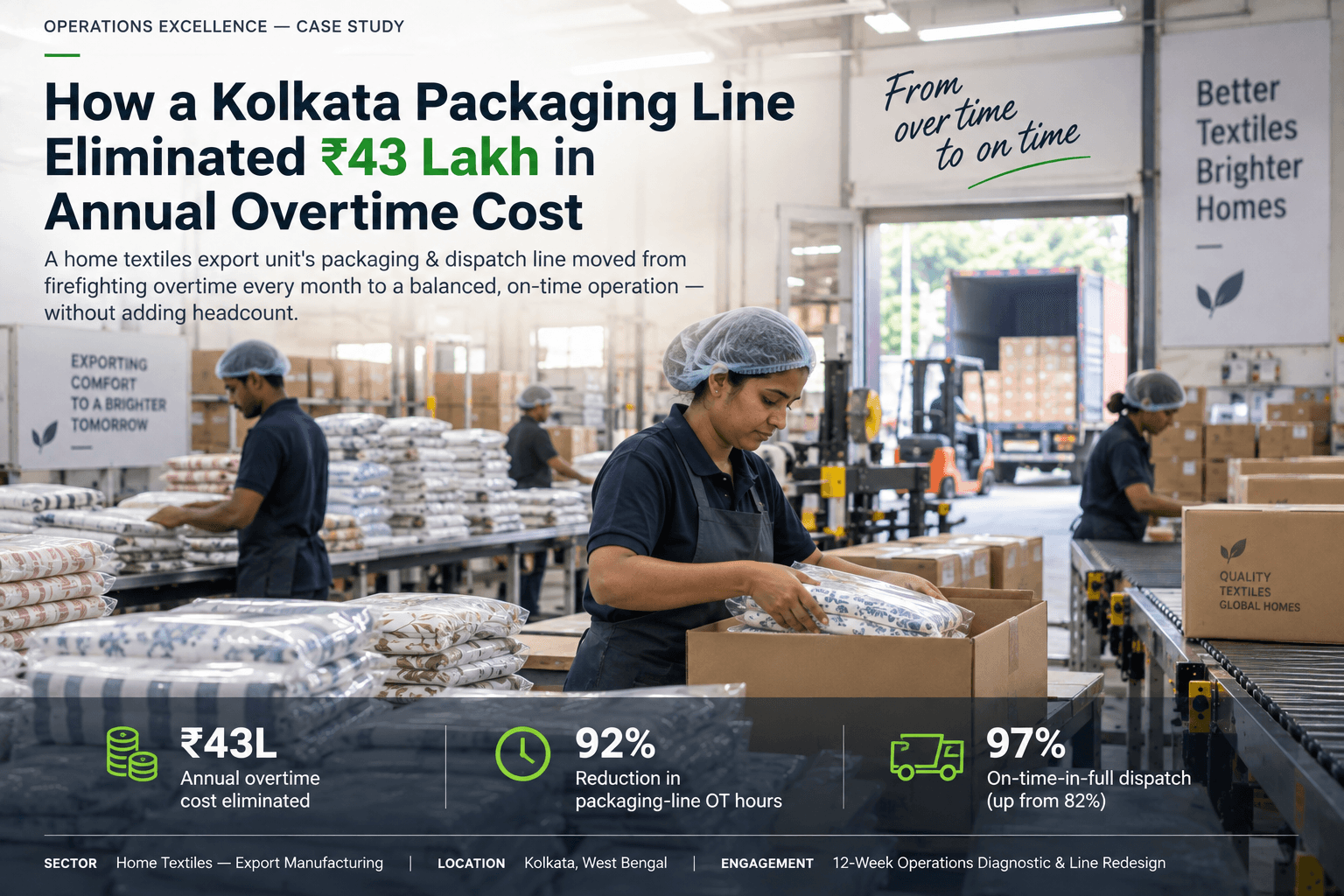
A home textiles export unit's packaging & dispatch line moved from firefighting overtime every month to a balanced, on-time operation — without adding headcount.
₹43L Annual overtime cost eliminated | 92% Reduction in packaging-line OT hours | 97% On-time-in-full dispatch (up from 82%) |
SECTOR Home Textiles — Export Manufacturing
LOCATION Kolkata, West Bengal
ENGAGEMENT 12-Week Operations Diagnostic & Line Redesign
CLIENT SNAPSHOT
| Business | Mid-sized manufacturer and exporter of bedsheets, curtains and cushion covers, supplying retail chains across Europe and the US. |
| Workforce | ~460 employees; 38 on the packaging & dispatch line across two shifts. |
| The problem | The packaging line was routinely running 3–4 hours of overtime a day to hit container cut-off times, adding up to roughly ₹43 lakh a year — with dispatch delays still slipping through. |
| Our mandate | Diagnose the root causes of chronic overtime and redesign the line to hit daily dispatch targets within a single regular shift. |
The client's packaging line — where finished bedsheets and curtains are folded, poly-bagged, labelled, cartoned and palletised for export — had become the most expensive room in the factory. Overtime had quietly become 'the way the line runs' rather than an exception.
Three months of payroll and production data told a consistent story:
— Overtime bill of roughly ₹3.5–3.7 lakh a month on the packaging line alone, close to ₹43 lakh annualised, against a sanctioned OT budget of under ₹10 lakh.
— A single bottleneck workstation — manual poly-bagging and carton sealing — running at under 60% of the line's average pace, forcing every other station to wait or rework.
— SKU changeovers (sheet size, print, packaging spec) eating 25–30 minutes each, several times a shift, with no standard changeover sequence.
— Dispatch planning disconnected from production planning, so high-priority container loads were often only flagged to the floor supervisor on the morning of loading.
— On-time-in-full (OTIF) dispatch performance of just 82%, despite the overtime spend — the extra hours were compensating for the delay, not preventing it.
Leadership's conclusion going into the engagement: this looked like a capacity problem. Our diagnostic found it was a balance and scheduling problem — and capacity was being paid for twice.
We ran a focused, floor-first engagement rather than a desk-based study. The team spent the first two weeks on the shop floor before recommending a single change.
Phase 1 — Diagnose (Weeks 1–2)
— Time-and-motion study of every workstation on the packaging line, across both shifts, to map actual cycle times against takt time.
— Twelve-week overtime and payroll audit to separate genuine demand-driven OT from OT caused by internal inefficiency.
— Pareto analysis of stoppage and delay logs to isolate the few causes driving most of the lost time.
Phase 2 — Redesign (Weeks 3–6)
— Rebalanced the line against takt time, splitting the overloaded poly-bagging and sealing step into two workstations and redistributing tasks so no station carried more than 105% of takt.
— Cross-trained operators across three adjacent stations, so the line could absorb a bottleneck without stopping and without calling in extra hands.
— Standardised a changeover sequence (SMED-style) for the recurring size/print/packaging changes, cutting changeover time from ~28 minutes to under 10.
— Introduced a simple hourly visual production board so supervisors could see a developing shortfall by 11 a.m. instead of discovering it at 6 p.m.
Phase 3 — Stabilise & Handover (Weeks 7–12)
— Linked the daily production plan directly to the dispatch/container schedule, so priority orders were sequenced onto the line a day ahead, not flagged on the morning of loading.
— Recommended and helped select a low-cost semi-automatic carton strapping and sealing unit for the former bottleneck station.
— Trained supervisors to run the visual board and changeover routine independently, with a 4-week shadow period before full handover.
| Area | Before | After |
| Line balance | One station at 58% of takt pace; rest of line waiting on it | Rebalanced across two stations, running at 92–98% of takt |
| Changeover time | ~28 minutes, ad hoc sequence | Under 10 minutes, standard sequence |
| Staffing model | Fixed roles; bottleneck absorbed only via overtime | Cross-trained pool floats to the bottleneck as needed |
| Sealing & strapping | Fully manual | Semi-automatic unit at former bottleneck station |
| Dispatch visibility | Priority loads flagged same-day | Production plan sequenced a day ahead of loading |
Within twelve weeks of the redesign going live, the packaging line was consistently clearing its daily dispatch target inside the regular shift.
₹43L → ~₹3L Annualised packaging-line overtime cost, before vs. after — a 92% reduction, with the residual limited to genuine peak-season demand. | 82% → 97% On-time-in-full dispatch performance, achieved with fewer paid hours than before, not more. |
61% → 88% Line balancing efficiency, closing the gap between the slowest and fastest workstations. | 2.9 months Payback period on the ₹9.5L strapping and sealing equipment, funded entirely from OT savings. |
Beyond the headline OT number, the plant also saw fewer last-minute rush trucks to the port, lower rework on mislabelled cartons, and a marked drop in supervisor escalations after 6 p.m. — the informal marker the client's ops head used to describe a 'normal' day before the engagement.
“ We had convinced ourselves we needed more people on that line. What we actually needed was a better sequence and a way to see trouble by lunchtime instead of at closing time. The overtime just wasn't there to spend anymore. — Plant Operations Head, Client (name withheld on request) |
Overtime on packaging and dispatch lines is rarely a headcount problem first. In almost every home textile plant we've worked with, it traces back to a small number of fixable causes:
— 1. An unbalanced line, where one manual step quietly sets the pace for everyone else.
— 2. Changeovers treated as unavoidable downtime rather than a process that can be standardised and timed.
— 3. Production planning that finds out about dispatch priorities the same day loading happens.
None of these require a large capital outlay to fix. In this engagement, the equipment investment was under ₹10 lakh — a fraction of the annual overtime it replaced — and paid for itself in under three months.
Running a packaging or dispatch line that's carrying more overtime than it should?
Madasky Consulting runs focused operations diagnostics for home textile manufacturers — typically a 2-week floor assessment followed by a costed redesign plan, before any commitment to a full engagement. Get in touch to discuss your plant.