
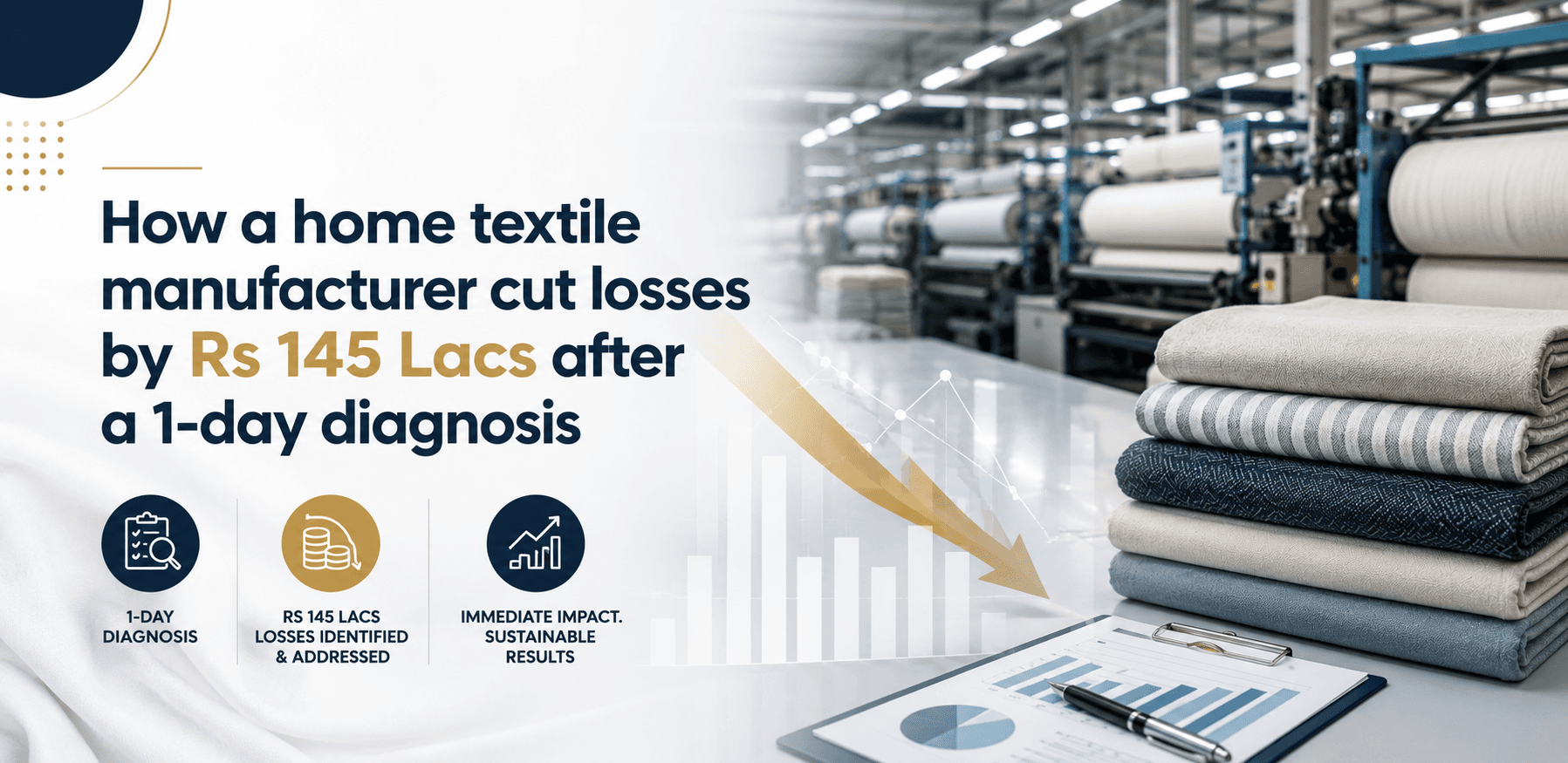
A mid-size home textile exporter had been running for eleven years. Experienced team, stable buyers, no visible crisis. What one structured day of diagnosis uncovered changed how they thought about profitability entirely. IndustryHome textile — export ScaleRs 38 Cr annual turnover Engagement1-day operational diagnosis OutcomeRs 145 Lacs loss identified & addressed
A factory that felt fine — and wasn't
When I walked in, the client's production head greeted me with a phrase I've heard many times before: "We're not perfect, but we're managing." Shipments were largely on time. The buyer list was intact. Turnover had grown modestly year on year.
What nobody had measured was the cost of managing. Every season carried the same quiet friction — late-stage rework, revised orders that caught procurement off guard, samples that bounced back without clear written reasons. Each instance felt isolated. Together, they were a pattern.
Recurring rework
Spec corrections discovered at inspection, not at sampling stage
Excess inventory
Greige fabric and yarn procured against verbal order intent, not written confirmation
Approval delays
Machines sitting idle while samples awaited buyer feedback through long relay chains
The diagnosis
One day. Four walkthroughs. One structured debrief.
The day was structured around four walkthroughs — the sampling room, the production floor, the warehouse, and a two-hour session with the merchandising and sourcing teams. No questionnaires. No pre-prepared reports. Just direct observation and one repeated question: where does the instruction change between what the buyer said and what the factory executes?
How the day was structured
1 Sampling room walkthrough — tracing how buyer feedback reaches the factory floor
2 Production floor observation — identifying where machines wait and why
3 Warehouse review — mapping uncommitted inventory against current order book
4 Merchandiser & sourcing session — surfacing where verbal instructions replace written ones
What we found
Rs 145 Lacs spread across four avoidable failure points
Rs 58 L
Rework costs — lot-level corrections at or after inspection
Rs 42 L
Dead inventory — fabric bought against orders that were revised or cancelled
Rs 28 L
Idle machine time — approval delays with no escalation protocol
"The largest single cost — Rs 58 Lacs in rework — traced back to one structural gap: buyer spec conversations happening verbally, with no mandatory written confirmation before the tech pack was treated as final."
Diagnostic debrief, end of day
Home textile orders carry a level of attribute density that other categories don't. Thread count, weave construction, finish treatment, dobby border specification, fill weight, labelling compliance — a single order can carry thirty or more distinct parameters. When even one of those is communicated verbally and not transcribed, the error doesn't surface at sampling. It surfaces six weeks later, at pre-shipment inspection, on an entire production lot.
What changed
Three protocol changes. No capital investment.
Results — 9 months on
Rs 89 L
Losses recovered or prevented within the first 9 months
Zero
Lot-level rework rejections since the written confirmation rule was enforced
Rs 31 L
Inventory value recovered through re-allocation and secondary channel liquidation
6 days
Reduction in average approval loop turnaround after escalation protocol was introduced
The question this engagement left behind
At the end of the diagnostic day, the production head asked me: "Why didn't we see this ourselves?" The honest answer is that these losses had become part of the background. Each one, in isolation, felt manageable. None of them appeared as a line item. They lived in the space between what the metrics tracked and what the system was actually doing.
One structured day — with the right questions, asked in the right rooms — was enough to make them visible. The rest was process.
What appears to be a production problem is often a process problem. What appears to be a sourcing issue is often a communication issue. And what appears to be a manageable cost is often a hidden drain on profitability.
Madasky Consulting works with textile, garment, and home textile manufacturers to identify these gaps, quantify their impact, and implement practical solutions that deliver measurable results.
To discuss your operational challenges, reach us at info@madasky.com or visit www.madasky.com.